Note 01 / monumental composition
How to read the structure of a temple wall
The first useful question is not “What does this sign mean?” It is “Where does this unit begin, and how does it belong to the scene?”
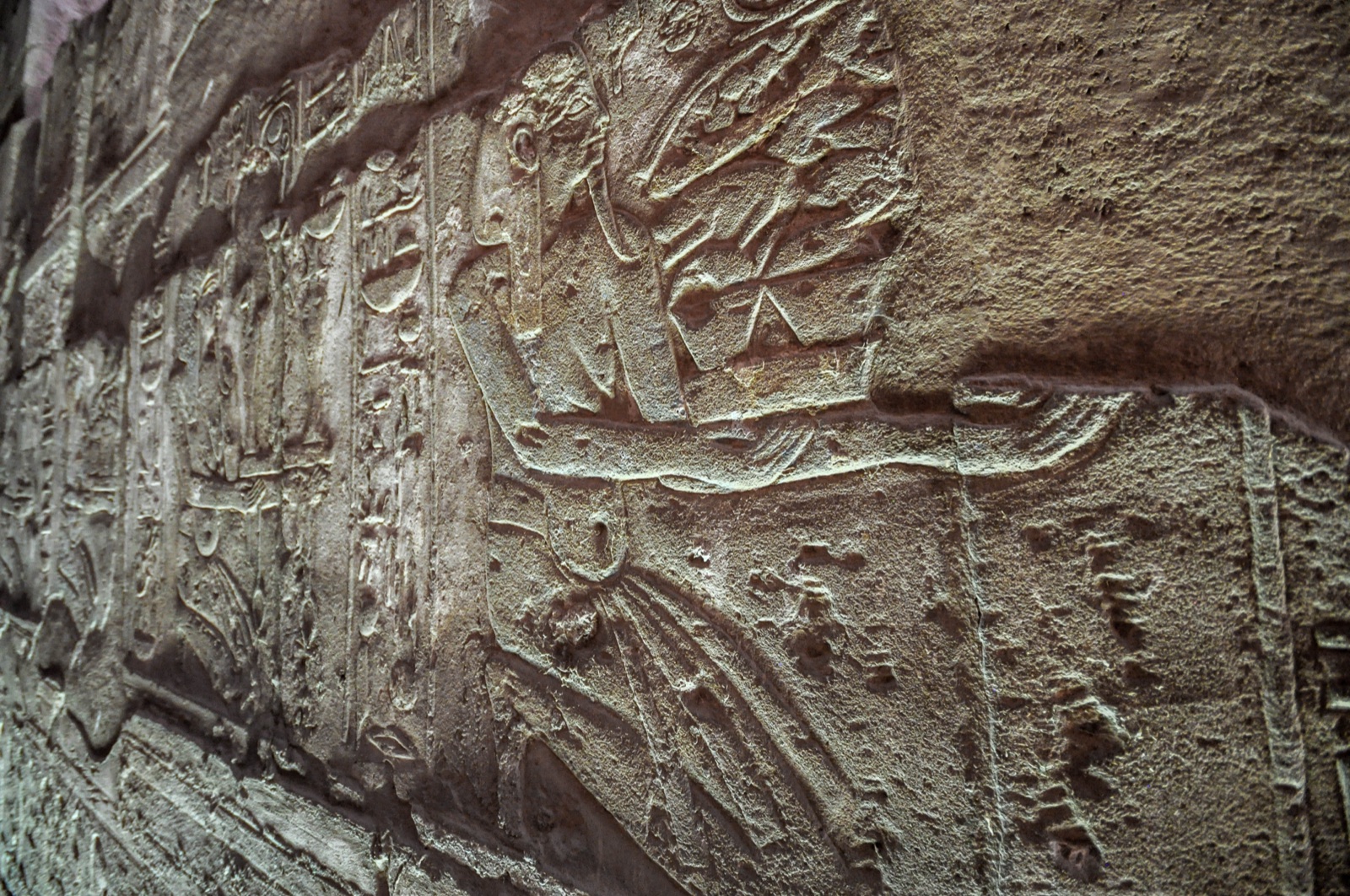
Monumental Egyptian writing was composed for architecture. Columns, doorways, figure groups, offering scenes and bands of text work together, so a cropped sign can lose the visual grammar that gives it a place. You can learn a great deal without claiming to translate: record the location, identify a bounded unit, find its likely direction, and distinguish carved surface from later loss or repair. That sequence turns a striking photograph into a usable observation.
Find the direction before the words
Hieroglyphic text can run from right to left or left to right, and it can be arranged in horizontal lines or vertical columns. Human and animal signs generally face toward the beginning of the line: if they look right, the reader normally begins at the right and moves left. This is an orientation rule, not a translation. Check several clearly preserved figures because damage, mirrored compositions and adjacent columns can make one isolated sign misleading.
Vertical columns still have a horizontal direction as well as a top-to-bottom sequence. Photograph enough neighbouring columns to see whether they belong to one block or face a central figure from opposite sides.
Orientation check
Locate three intact human or animal signs. Note where they face, the top and bottom of the text unit, and the architectural edge that contains it. Do not rotate the image until those facts are recorded.
Read registers as containers
A register is a horizontal zone that organises figures and text. Ground lines, borders, door jambs or changes in scale may separate one unit from the next. First map those boundaries with your eye. A caption beside a deity, a royal name above a figure and a long band near the ceiling may serve different roles even when their signs look similar. Treating the entire wall as one continuous paragraph erases that structure.
Image and inscription share the field
Figures do not merely illustrate a detachable text. Gesture, direction, scale and proximity help organise the composition. A row of signs above an offering can belong to that action; a short column near a face may identify or describe the adjacent figure. Keep the figure in the middle frame of your photo sequence. It prevents a later close-up from floating free of the scene it accompanied.
Let carving and light remain visible
Incised signs catch shadow differently from raised relief, and sunlight can make shallow carving appear deeper than it is. Record whether the surface is in direct sun, open shade or interior light. Do not apply aggressive contrast until chips and shadows become identical black shapes. A natural frame plus a lightly adjusted working copy is more honest than one dramatic image that hides the stone.
Never rub, chalk, wet or trace a carved sign. Those interventions can damage a monument and create a false surface for later visitors.
One wall can contain several episodes
Egyptian monuments were built, altered, restored and reused over long periods. Differences in depth, scale, alignment or stone do not by themselves prove a date, ruler or historical event. They are prompts for checking an official site publication or scholarly record. State the visible difference first: “the upper band is shallower and crosses a joint.” Leave chronological attribution to evidence that can support it.
A cartouche is evidence, not a shortcut
The oval frame called a cartouche is strongly associated with royal names, but recognising the frame does not make a visitor able to identify its contents. Egyptian royal titulary involves several names and titles, and monuments can name more than one ruler. Copy the complete group, its reading direction and its position in the scene. Then compare it with a reliable publication; do not match one familiar-looking sign to a search result and declare the wall dated.
Build a four-line field record
Write the site and exact area; the architectural surface; the direction and boundaries of the text unit; and the filename of your wide, middle and detail frames. Add the wording of any nearby official panel separately. This small record preserves what a phone gallery cannot: why the detail mattered and where it belonged. If access rules prevent a photograph, make a verbal description rather than a rubbing or touch-based trace.
Stop at the edge of your evidence
A visitor can responsibly describe layout, orientation, material and preservation. Transliteration and translation require language knowledge, sign forms, grammar and comparison with published texts. Saying “I can see the beginning of a right-to-left column beside the figure” is more useful than attaching an unverified sentence to it. The wall remains readable as an organised object even when its words are not yet yours to translate.